10 Must See Art Shows and Exhibitions in NYC This November
New York’s art calendar is active this November. From major museum shows to focused gallery exhibitions, these ten picks are worth planning for.

Mathew Cerletty: End of the Line | Source: Karma
November in New York always brings a different rhythm. The air cools, the days shorten and the city settles into a pace that makes wandering through museums and galleries feel especially good. This month’s lineup ranges from long-awaited museum projects to concentrated gallery shows that highlight artists working across painting, sculpture and experimental materials. Whether you are catching something new or revisiting a familiar name, there is plenty worth seeing as the season moves ahead.
1. Louise Bourgeois | Gathering Wool

Louise Bourgeois: Gathering Wool | Source: Hauser & Wirth
Where: Hauser & Wirth, 22nd Street, New York
When: November 6, 2025 – January 24, 2026
Gathering Wool focuses on Bourgeois’s long, often overlooked relationship with abstraction. The exhibition gathers late sculptures, reliefs and works on paper, many never shown before, and places them alongside earlier pieces to trace how her symbolic forms developed over time. Key works include Twosome (1991), a motorized installation that reflects the mother and child relationship, and Gathering Wool (1990), an early precursor to her Cell installations. Across the galleries, motifs of protruding forms, stacking, repetition and fragile balance reveal how she used abstraction to explore containment, emotion and the shifting line between conscious and unconscious thought.
About the Artist: Bourgeois, born in France in 1911 and active in New York until her death in 2010, created work shaped by memory, psychological tension and personal mythology. She moved across sculpture, drawing and installation, often returning to symbols drawn from childhood, including body parts, houses and spiders. Her abstractions grew from emotional states, using stacking, interlocking forms and repeated elements to explore obsession, fragility and fear. The exhibition offers a focused view of how these ideas took shape.
2. Agnes Martin | Innocent Love
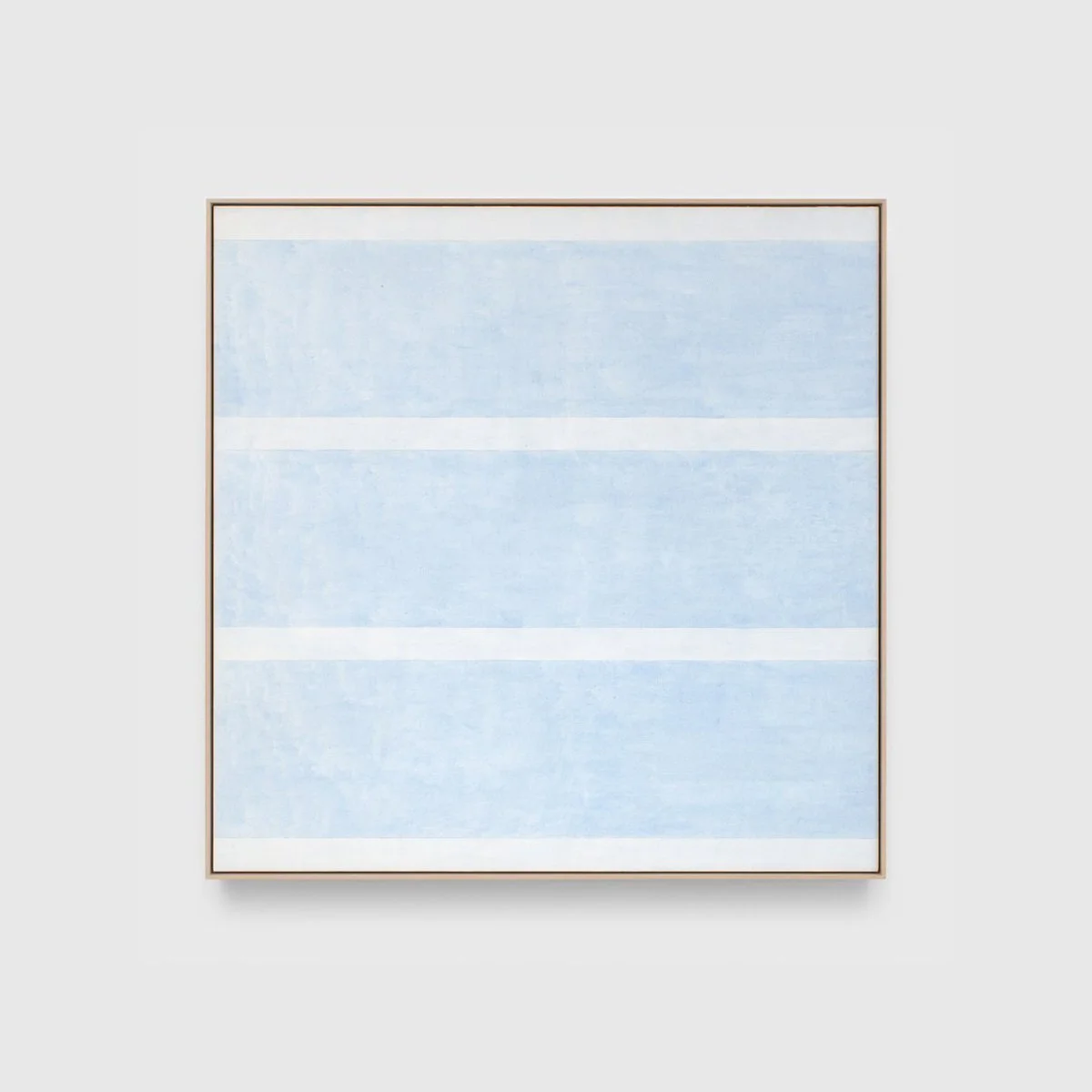
Agnes Martin: Innocent Love | Source: Pace Gallery
Where: Pace Gallery, 540 West 25th Street, New York
When: November 7 – December 20, 2025
Innocent Love brings together thirteen late-career canvases by Agnes Martin, made between the late 1990s and early 2000s. These works show her shifting into brighter color and more open geometry while still relying on the measured lines and steady compositions that shaped her entire practice. The series reflects her interest in expressing the freedom and imagination associated with childhood, a direction she underscored through titles like Tranquility, Gratitude, Blessings and I Love Love. This is Pace’s final exhibition of its 65th anniversary year, and it offers a focused look at the last major body of work Martin completed. A new publication of Martin’s writings accompanies the show, adding another layer of context to this late period.
About the Artist: Born in Saskatchewan in 1912, Agnes Martin became a key figure in twentieth-century painting, developing an abstract language rooted in philosophy, repetition and a pursuit of calm. Her years in New Mexico and New York shaped her engagement with Zen thought and her steady refinement of grids, stripes and subtle color shifts. Though often associated with Minimalism, her work remained tied to personal and emotional concerns. Martin began working with Pace in 1975 and continued until her death in 2004, presenting nearly three decades of exhibitions that explored how line and color can reflect an inner state.
3. Richard Prince | Folk Songs

Richard Prince: Folk Songs | Source: Gagosian
Where: Gagosian, 555 West 24th Street, New York
When: November 6 – December 20, 2025
Folk Songs brings together new handmade work by Richard Prince, spanning paintings, drawings and collages made between 2018 and 2023, along with five sculptures created from 2007 to 2025. The exhibition leans fully into raw, tactile materials and imagery from American vernacular culture. Prince assembles scenes filled with broken down houses, exaggerated flowers, cardboard caskets, jellied toast, plastic six pack dresses, and fence fragments from an old drive-in theater. The work feels deliberately stripped back. No digital effects, no sleek surfaces, just direct encounters with objects, references and improvisations. From ten foot poles to outboard motors, boot-strung guitars and beaver gnawed tree trunks, the pieces form a constellation of rural symbols, roadside detritus and oddball Americana. Prince calls attention to the handmade and the imperfect, creating an environment that feels both familiar and unsettled.
About the Artist: Richard Prince has spent over four decades reworking images from magazines, advertising and mass media to question authorship, authenticity and cultural memory. His interest in American subcultures, from cowboys to car culture and pulp fiction, has shaped a practice that spans painting, photography, collage and sculpture. Born in 1949 in the Panama Canal Zone and based in New York, he has had major exhibitions at the Guggenheim, the Whitney and institutions worldwide. Prince often works at the edge of public identity and private desire, drawing from everyday American imagery to create a distinct and recognizable visual language.
4. Tetsuya Yamada | 7 Sculptures and Paintings in Ceramic

Tetsuya Yamada: 7 Sculptures and Paintings in Ceramic | Source: Paula Cooper Gallery
Where: Paula Cooper Gallery, 529 West 21st Street, New York
When: October 18 – November 29, 2025
This exhibition presents ceramic sculptures and wall reliefs that highlight Tetsuya Yamada’s ongoing interest in testing what clay can do. The works use ceramic in ways that feel unexpected, often disguising the material through glaze and surface treatments. Two intersecting tube forms are finished to resemble aluminum or oxidized copper, while a piece from the Gravitation series folds a thin slab of clay over a rope like fabric. On the walls, works from Smoke (2013) and Dust after the Rain (2021) demonstrate Yamada’s attention to texture. Fingertip indentations in the earlier series create shimmering metallic surfaces, while the more recent panels incorporate scattered glass beads that melt into small points of color. Several sculptures come from his 2024 survey at the Walker Art Center, giving this presentation a direct link to his broader practice.
About the Artist: Born in Tokyo in 1968, Yamada trained in traditional Japanese ceramics before moving to the United States in 1994. He earned his MFA at Alfred University and now teaches at the University of Minnesota. His work has been shown at the Walker Art Center and Midway Contemporary Art, and he often stages small, self-organized exhibitions around Minneapolis. Yamada has participated in major ceramic residencies and received awards including a Tiffany Award, several McKnight Fellowships and a 2023 Guggenheim Fellowship. His practice combines material experimentation with precise technique, allowing clay to shift into new forms.
5. High Wire: Calder’s Circus at 100

High Wire: Calder’s Circus at 100 | Source: Whitney Museum of American Art
Where: Whitney Museum of American Art, Floor 8, New York
When: October 18, 2025 – March 9, 2026
This exhibition marks the hundredth anniversary of Calder’s Circus, the artist’s improvised world of wire figures, animals and performers that he began creating in Paris in 1926. Using simple materials like wood, metal, cork and fabric, Calder staged full performances with music, lighting and acrobatic tricks, manipulating each figure from the floor in shows that could run for two hours. The Whitney brings this work together with circus-themed wire sculptures, drawings, archival material and early abstract pieces to show how the circus became a framework for Calder’s interest in motion, balance and structure. Seen in relation to the work he developed after 1931, the exhibition offers a clear link between these early handmade performers and the later mobiles that shaped his career.
About the Artist: Alexander Calder, born in 1898, drew early inspiration from popular entertainment, engineering and the energy of the circus. During his years in Paris he moved among artists like Duchamp, Miró, Mondrian and Noguchi, many of whom saw his early performances. His interest in mechanics and space led him toward abstraction and eventually to the mobile, which became central to his practice. Working with wire, metal and everyday materials, Calder created sculptures animated by humor, motion and structural clarity. His inventive approach continues to shape how artists think about movement and form.
6. Robert Rauschenberg: Life Can’t Be Stopped

Robert Rauschenberg: Life Can’t Be Stopped | Source: Solomon R. Guggenheim Museum
Where: Solomon R. Guggenheim Museum, New York
When: October 10, 2025 – May 3, 2026
This exhibition celebrates Robert Rauschenberg’s 100th birthday with more than a dozen key works from the Guggenheim’s collection, joined by major loans from the Robert Rauschenberg Foundation. Together they show the full range of his inventive approach to materials and media. The centerpiece is Barge (1962–63), a thirty-two-foot silkscreen painting created largely in a single day, which returns to New York for the first time in almost twenty-five years. As one of the largest works from his Silkscreen Paintings series, it anchors the presentation and underscores how Rauschenberg used scale, speed and mechanical processes to rethink what painting could be. The exhibition is organized by Joan Young, Senior Director of Curatorial Affairs.
About the Artist: Rauschenberg’s career, which began in the late 1940s, was defined by a readiness to merge disciplines and expand what painting could include. He incorporated everyday objects and photographic imagery, dissolving boundaries between mediums and opening the way for his celebrated Combines, which blended sculpture, collage and painted gesture. Throughout his life he worked collaboratively with performers, printmakers, engineers and writers, treating art as an active exchange rather than a fixed category. His belief that art is intertwined with daily experience shaped a practice that remained experimental and influential across generations.
7. Mathew Cerletty | End of the Line

Mathew Cerletty: End of the Line | Source: Karma
Where: Karma, 22 East 2nd Street, New York
When: November 7 – December 20, 2025
End of the Line presents eleven new paintings created over the past year, expanding a visual language Cerletty has been refining since 2018. Each canvas features a single, precisely rendered object placed at the center of the composition and set against a solid field of color. His source material often comes from advertisements, but through repeated drawing and painting he transforms everyday items into distilled, near-iconic forms. Works like Messenger, where a manila envelope is elevated to something almost ceremonial, or diptychs featuring legs in pantyhose, sponges, envelopes and towels, take on new meaning through scale, color and placement. Cerletty’s surfaces reveal careful brushwork and a commitment to painting as a physical process. The exhibition creates subtle conversations between the works, letting color, texture and subject shift from one canvas to the next in ways that quietly question how we read images and how paintings operate in a world saturated with digital pictures.
About the Artist: Mathew Cerletty, born in 1980 in Wauwatosa, Wisconsin, is known for hyperreal paintings of everyday objects that balance familiarity with a subtle strangeness. His surfaces often appear seamless, yet closer looking shows a clear attention to craft and the presence of the hand. Drawing from popular culture without leaning into straightforward Pop, he works in oil to explore the space between image and object. Cerletty lives in Brooklyn and has exhibited widely in the United States and Europe, with recent solo shows in London, Oslo, Los Angeles and New York. His work is held in public collections including the Whitney Museum of American Art, the Institute of Contemporary Art in Miami and the Milwaukee Art Museum.
8. Machteld Rullens | Beacon Road

Machteld Rullens: Beacon Road | Source: Andrew Kreps Gallery
Where: Andrew Kreps Gallery, 394 Broadway, New York
When: November 7 – December 20, 2025
Beacon Road is presented across Andrew Kreps Gallery and PAGE (NYC), gathering new works created during Machteld Rullens’s summer residency at the Josef and Anni Albers Foundation. The exhibition focuses on her ongoing interest in how discarded materials can be reworked into painterly objects. Using cardboard as her base, Rullens applies layers of oil, acrylic and pigment before sealing the surfaces with resin. She breaks down boxes, flattens them, rebuilds them and paints throughout the process, allowing folds, creases and stacked sections to guide new forms. In this body of work she pushes further into the tension between painting and sculpture. Some pieces compress multiple boxes into dense, layered structures, while others adopt gridded compositions that nod to Josef Albers’s Homage to the Square. The surfaces appear flat at first glance, yet traces of fastening, bending and bolting remain visible, reminding viewers of the labor embedded in each piece.
About the Artist: Machteld Rullens, born in 1988 in The Hague, works between painting and sculpture by transforming everyday materials into structured, layered forms. She studied at the Piet Zwart Institute in Rotterdam and the Royal Academy of Art in The Hague. Recent solo shows have taken place in Mexico City, Rotterdam, Brussels, New York and Los Angeles, and her work appears in collections including the Hammer Museum, the AkzoNobel Art Foundation and the Celine Collection. Her practice merges experimentation with a clear formal sensibility, linking contemporary material culture to modernist ideas.
9. Sean Scully | Tower
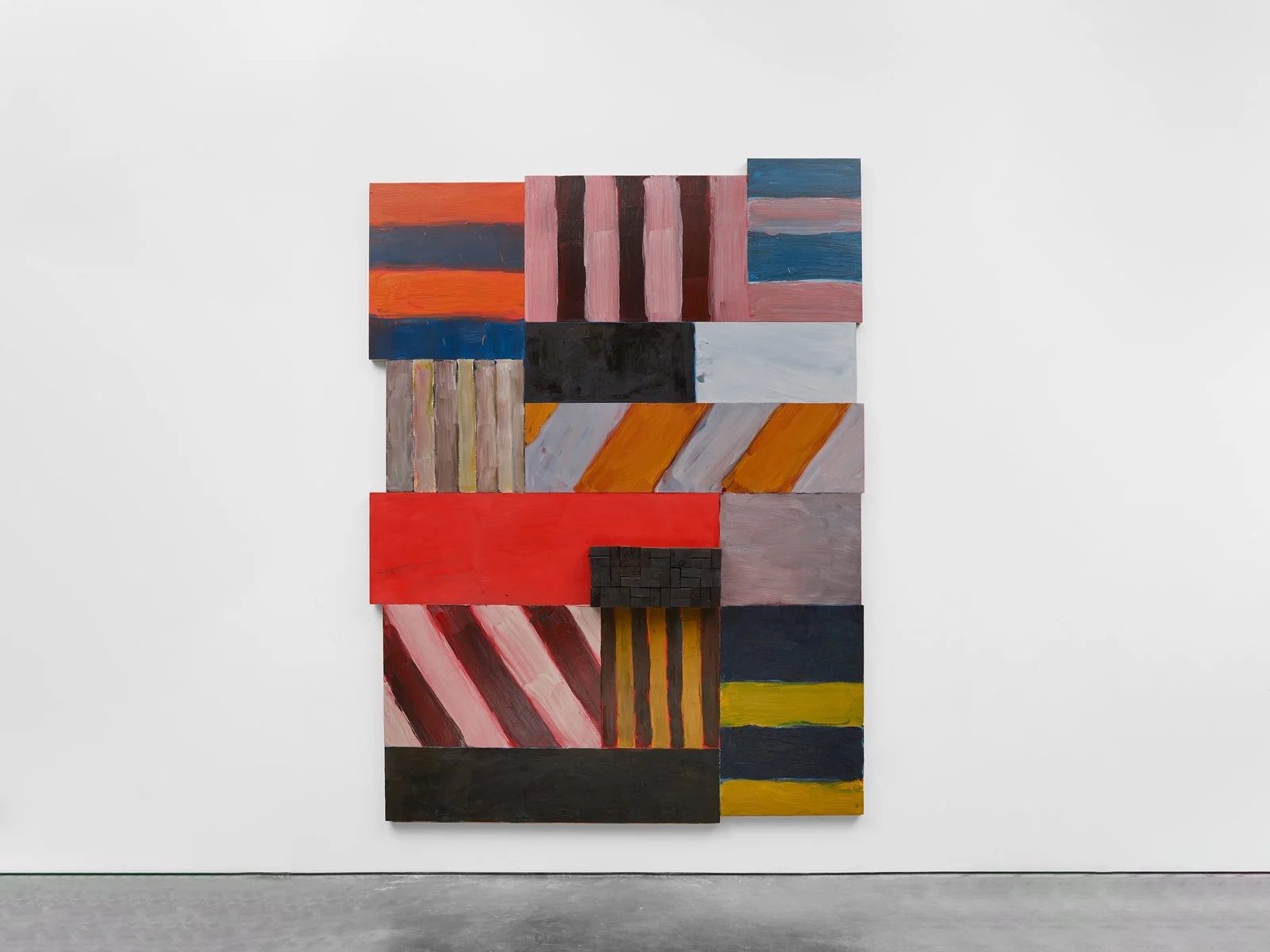
Sean Scully: Tower | Source: Lisson Gallery
Where: Lisson Gallery, 508 West 24th Street, New York
When: November 6, 2025 – January 24, 2026
Tower introduces a new direction in Sean Scully’s practice, built around paintings composed from multiple smaller panels assembled into stacked, irregular formations. These constructions mix gestures, grids, holes and moments pulled from across his career, creating a rhythm shaped by interruption. Materials like wood, felt and aluminum, along with spray-painted marks and hints of signage, bring a sculptural quality to the series and echo the density of contemporary architecture. The exhibition also includes paintings on copper, where shifts of color reveal the metal beneath, and three stone sculptures that offer a steadier counterbalance to the more fractured Tower works.
About the Artist: Sean Scully, born in Dublin in 1945 and based between New York and London, is known for abstract paintings built from stripes, blocks and layered grids. His work connects the rigor of modernist structure with the atmosphere and emotion of European painting. Over a five-decade career he has worked across painting, sculpture, watercolor and printmaking, and his work is held in major collections including MoMA, the Metropolitan Museum of Art, the Guggenheim and Tate Modern. Scully continues to explore how form, surface and scale can carry feeling, a thread that runs through this new body of work.
10. Luc Tuymans | The Fruit Basket

Luc Tuymans: The Fruit Basket | Source: David Zwirner
Where: David Zwirner, 19th Street, New York
When: November 6 – December 19, 2025
The Fruit Basket presents a new group of paintings by Luc Tuymans, created for his eighteenth solo exhibition with David Zwirner. The show considers the fractured atmosphere shaping life in the United States today, using a mix of subjects and shifts in scale to reflect the instability of mediated experience. Tuymans adjusts the intensity of his palette to amplify the artificiality of the images he chooses, allowing the works to sit between clarity and distortion. The unexpected rhythm of the presentation invites viewers to move between different registers of realism and abstraction, reinforcing the unsettled mood that runs through the exhibition. This body of work will travel to David Zwirner Los Angeles in early 2026.
About the Artist: Luc Tuymans, born in 1958 in Mortsel, Belgium, is widely recognized for paintings that draw from historical events, media imagery and filtered memory. Since the 1990s he has exhibited internationally, including major museum presentations and multiple solo shows with David Zwirner, where he has been represented since 1994. Tuymans lives and works in Antwerp, and his work is held in major collections such as MoMA, Tate, Centre Pompidou and the Guggenheim. His practice remains centered on how images are constructed, circulated and interpreted.